Guide
Block paving, tarmac or resin? Choosing a driveway surface
A new driveway is a big investment and the first thing people see of your home. Each surface has its strengths — here is a straightforward comparison to help you decide.

Block paving
Block paviours, country cobbles and granite setts come in many colours and sizes and can be laid in patterns, with borders and contrasting bands to break up large areas.
- Pros: very attractive and flexible in design; individual blocks can be lifted and relaid for repairs; permeable versions are available.
- Cons: joints need occasional re-sanding and weed control; standard block paving is not permeable, so drainage must be planned.
Tarmac
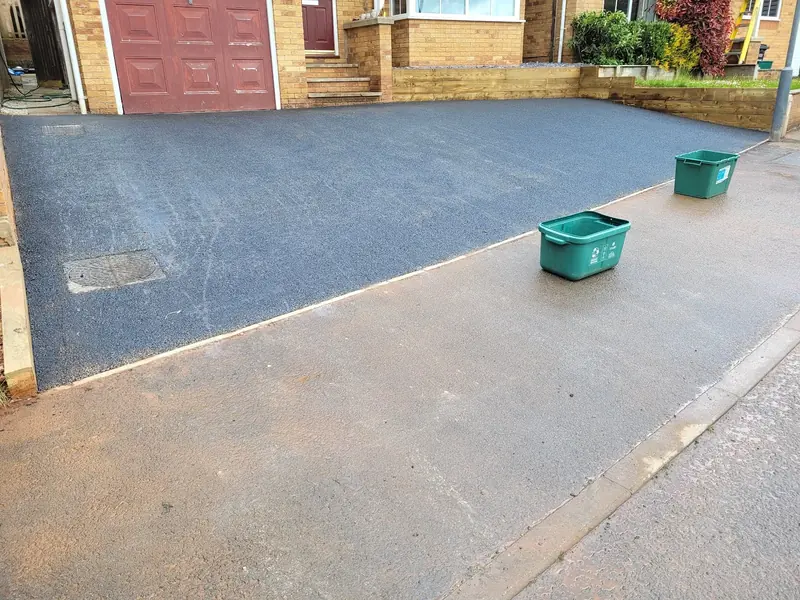
Tarmac (tar-macadam) is long-lasting, durable and low maintenance, and is often the most cost-effective option for larger areas. Edged with block paviours, sleepers or kerbs, it gives a clean, crisp finish. We can also apply a restoring product to revive old, discoloured tarmac.
- Pros: hard-wearing, smooth, quick to lay, good value.
- Cons: plainer look; standard tarmac is impermeable unless drained to a soakaway or border.
Resin bound
Aggregate is mixed with resin and trowelled to a smooth, level surface. It is permeable, so it usually avoids the need for planning permission on front gardens, and there is a wide choice of stone colours.
- Pros: smooth, seamless and modern; permeable and SuDS compliant; very low maintenance; no loose stones.
- Cons: needs a sound, well-prepared base; colour choice is permanent.
Resin bonded
Stones are scattered over a layer of resin, giving a textured, non-slip finish that is ideal for steep driveways. Unlike resin bound, it is not permeable.
Gravel and gravel grids
Gravel is affordable, permeable and suits rural and period homes. Laid over gravel grids — as on our Chilcompton driveway with Dorset gravel parking bays — it stays put, does not rut and is much easier to walk and park on.
Natural stone and pattern imprinted concrete
Natural stone such as reclaimed Yorkstone is the premium choice for character properties. Pattern imprinted concrete is long-lasting, weed free and stain resistant, with many patterns and colours to choose from.
What really makes a driveway last
Whatever the surface, the hidden work decides how long it lasts: proper excavation, a compacted sub-base laid in layers, firm edging, and drainage designed in from the start. On our Rode Yorkstone driveway we excavated nearly half a metre and laid 150mm of sub-base and 150mm of concrete before the stone went down — and it carries an electric car every day.
Written by the JSW Landscaping & Surfacing team · Updated October 2026