Guide
Do I need planning permission for a new driveway?
It is one of the first questions we are asked when someone is thinking about a new driveway. For most houses in England the answer is no — as long as the rainwater is dealt with properly. Here is how the rules work.

The short answer
Paving over a front garden is usually “permitted development” for houses, which means you do not need to apply for planning permission. The catch is drainage: since 2008 the rules have been designed to stop rainwater running off driveways into roads and drains, where it adds to flooding.
According to the government’s Planning Portal, you do not need planning permission for a new or replacement driveway of any size if it uses permeable (porous) surfacing, or if the rainwater is directed to a lawn or border where it can drain naturally.
The five square metre rule
If the new surface is more than five square metres and is not permeable — for example traditional block paving laid on a solid base, standard tarmac or plain concrete — and the water runs off towards the road, then planning permission is needed.
Five square metres is small — a single parking space is roughly twelve square metres — so almost every impermeable front driveway falls into this category. That is why the drainage design matters so much.
Ways to stay within permitted development
- Choose a permeable surface: resin bound, permeable block paving, gravel or gravel grids all let water soak through.
- Use a traditional surface but fall it towards a lawn, flower bed or gravel strip within your own property.
- Collect the water in channel drains (such as ACO channels) and take it to a soakaway on your land.
We design drainage into every driveway we quote for, and on many projects we install channel drains, gullies and soakaways so the surface you want stays within the rules.
When the rules are different
The permitted development allowance does not apply to every property. You should check with the council before starting work if:
- you live in a flat or maisonette, or a house converted from another use;
- the property is listed, or is in a conservation area (much of central Bath is, and the city is a World Heritage Site);
- a planning condition or an Article 4 Direction has removed permitted development rights — common on some newer estates;
- the work also involves new walls, fences or gates next to a road, which have their own height limits.
In our area there are two councils to check with: Bath & North East Somerset Council covers Bath, Midsomer Norton, Radstock, Westfield, Paulton, Peasdown St John and Timsbury, while Somerset Council covers Chilcompton, Coleford, Shepton Mallet, Frome and the Mendip villages.
Dropped kerbs
If you will drive across a pavement or verge to reach your new driveway, you need a dropped kerb, and driving over a full-height kerb without one is not allowed. A dropped kerb is on the public highway, so you must apply to your local council, which will either install it or approve a contractor to do it.
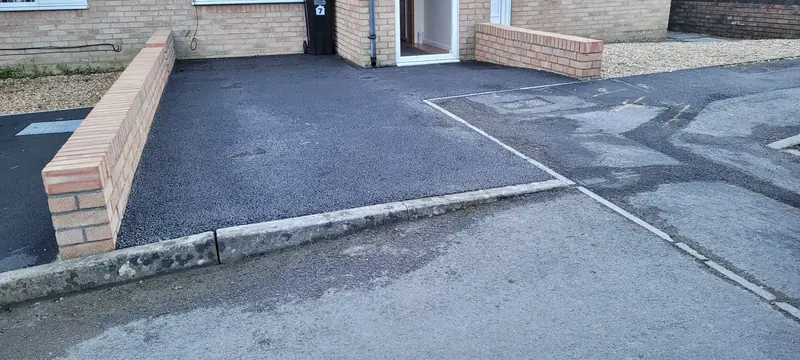
We can build your driveway ready for the dropped kerb and work around the council’s timetable — on one Bath project we built the driveway so the council could drop the kerbs afterwards.
Not sure?
Every property is different, and the national rules are only a guide. When we visit to quote we will explain the drainage options for your driveway and point out anything you may need to check with the council. Official guidance is on the Planning Portal: Paving your front garden.
Written by the JSW Landscaping & Surfacing team · Updated October 2026